ni.com is currently undergoing scheduled maintenance.
Some services may be unavailable at this time. Please contact us for help or try again later.
- Subscribe to RSS Feed
- Mark Topic as New
- Mark Topic as Read
- Float this Topic for Current User
- Bookmark
- Subscribe
- Mute
- Printer Friendly Page
Scripting Sometimes Deletes Wire

 paul_cardinale
03-25-2022 03:17 PM
- Mark as New
- Bookmark
- Subscribe
- Mute
- Subscribe to RSS Feed
- Permalink
- Report to a Moderator
I have a reference to an output terminal of a SubVI call. I execute this code to disconnect the terminal from the wire:
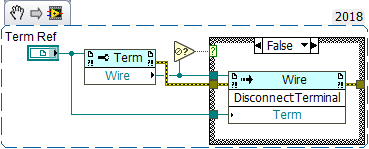
Sometimes it just disconnects leaving the broken wire (which is what I want); and sometimes the wire gets deleted (which I don't want because I need that wire later).
Whether or not the wire gets deleted seems to depend on which particular SubVI (in both cases it's an Express VI), and which particular terminal is involved.
I can't figure out what the difference is that sometimes causes the wire to disappear and sometimes remain intact.

 BertMcMahan
03-25-2022 04:15 PM
- Mark as New
- Bookmark
- Subscribe
- Mute
- Subscribe to RSS Feed
- Permalink
- Report to a Moderator
Any chance it has to do with either bends in the wire or branches in the wire? I can't reproduce it right now, but I feel like I've seen wires behave differently if they're straight vs bent or maybe branched vs. single-wired.
03-25-2022 04:37 PM
- Mark as New
- Bookmark
- Subscribe
- Mute
- Subscribe to RSS Feed
- Permalink
- Report to a Moderator
@BertMcMahan wrote:
Any chance it has to do with either bends in the wire or branches in the wire? I can't reproduce it right now, but I feel like I've seen wires behave differently if they're straight vs bent or maybe branched vs. single-wired.
That was my first thought; but nope.

 wiebe@CARYA

03-29-2022 07:05 AM - edited 03-29-2022 07:07 AM
- Mark as New
- Bookmark
- Subscribe
- Mute
- Subscribe to RSS Feed
- Permalink
- Report to a Moderator
Could LV's auto wiring algorithms be kicking in?
Also, is this reproducible and\or consistent?
 Search LabVIEW like a graph!
 03-29-2022 10:08 AM - edited 03-29-2022 10:09 AM
- Mark as New
- Bookmark
- Subscribe
- Mute
- Subscribe to RSS Feed
- Permalink
- Report to a Moderator
wiebe@CARYA wrote:
Could LV's auto wiring algorithms be kicking in?
Also, is this reproducible and\or consistent?
Turning off autowiring didn't help.
It's somewhat reproducible. The attached code manifests the problem, but if you edit "BUG.vi", the problem sometimes goes away (and may come back if you edit again).
- Unzip the file.
- Open the block diagram of BUG.vi
- Double-click on the Express VI.
- Click "OK" to close the configuration window.
- The error wires will be lost.
The loss of the wires happens when
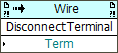
runs in "..\Universal Dialog Box\Support\Common\Utility\Scripting\Disconnect-Reconnect Wires on SubVI.vi"
03-29-2022 10:29 AM
- Mark as New
- Bookmark
- Subscribe
- Mute
- Subscribe to RSS Feed
- Permalink
- Report to a Moderator
Just found it: If the wire length is 32 pixels or less, the wire gets deleted, greater than that, and it remains intact.
wiebe@CARYA
03-30-2022 03:19 AM
- Mark as New
- Bookmark
- Subscribe
- Mute
- Subscribe to RSS Feed
- Permalink
- Report to a Moderator
@paul_cardinale wrote:
Just found it: If the wire length is 32 pixels or less, the wire gets deleted, greater than that, and it remains intact.
Definitely not desirable behavior when you're scripting...
03-31-2022 12:35 PM
- Mark as New
- Bookmark
- Subscribe
- Mute
- Subscribe to RSS Feed
- Permalink
- Report to a Moderator
wiebe@CARYA wrote:
@paul_cardinale wrote:
Just found it: If the wire length is 32 pixels or less, the wire gets deleted, greater than that, and it remains intact.
Definitely not desirable behavior when you're scripting...
Same thing happens with manual editing.
Still scratching my head on a workaround.
wiebe@CARYA
04-01-2022 04:01 AM
- Mark as New
- Bookmark
- Subscribe
- Mute
- Subscribe to RSS Feed
- Permalink
- Report to a Moderator
@paul_cardinale wrote:
wiebe@CARYA wrote:
@paul_cardinale wrote:
Just found it: If the wire length is 32 pixels or less, the wire gets deleted, greater than that, and it remains intact.
Definitely not desirable behavior when you're scripting...
Same thing happens with manual editing.
Still scratching my head on a workaround.
I guess a workaround is to 'record' the wire, disconnect the terminal, and if the wire is deleted, recreate the wire... If there's another terminal, you could use create described wire. If not, well, it's a lot of work... Both cases you loose the original UID...
You could try to re-route the wire (add joints, give it some length) so it isn't deleted. I suppose you can reroute in a way that it's easy to undo the rerouting.
04-04-2022 12:09 PM
- Mark as New
- Bookmark
- Subscribe
- Mute
- Subscribe to RSS Feed
- Permalink
- Report to a Moderator
wiebe@CARYA wrote:
@paul_cardinale wrote:
wiebe@CARYA wrote:
@paul_cardinale wrote:
Just found it: If the wire length is 32 pixels or less, the wire gets deleted, greater than that, and it remains intact.
Definitely not desirable behavior when you're scripting...
Same thing happens with manual editing.
Still scratching my head on a workaround.
I guess a workaround is to 'record' the wire, disconnect the terminal, and if the wire is deleted, recreate the wire... If there's another terminal, you could use create described wire. If not, well, it's a lot of work... Both cases you loose the original UID...
You could try to re-route the wire (add joints, give it some length) so it isn't deleted. I suppose you can reroute in a way that it's easy to undo the rerouting.
I discovered that the deletion won't happen if, after the disconnect, there are at least 2 terminals still connected.
So my workaround is:
- Place a wire-holder SubVI (it has a single terminal that's a variant)
- Connect the wire-holder SubVI to the wire.
- Disconnect the wire from the desired terminal.
- Delete the wire-holder SubVI
In the end, this leaves loose wire ends, so I have to remove those after I've reconnected.
