- Subscribe to RSS Feed
- Mark Topic as New
- Mark Topic as Read
- Float this Topic for Current User
- Bookmark
- Subscribe
- Mute
- Printer Friendly Page
Error ring excluded in executable?

 bokorpet
03-09-2015 11:07 AM
- Mark as New
- Bookmark
- Subscribe
- Mute
- Subscribe to RSS Feed
- Permalink
- Report to a Moderator
Hello,
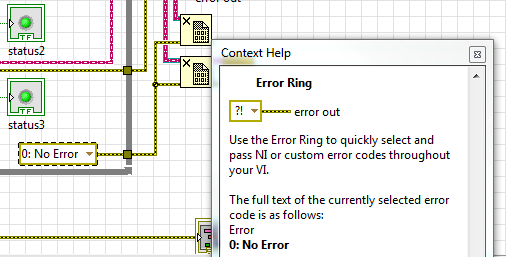
I encountered following strange behavior: when run in LabVIEW development, following error ring does its expected job as it also acts as a control flow control so that the reference is not destroyed before the loop terminates (see picture).
Strangely, when I build an executable and execute the VI via run-time, I the reference is destroyed WHILE the loop is still running. As if the error ring was not compiled into the executable.
Is it a LV bug?
Thanks,
Peter

 tst
tst

03-09-2015 11:24 AM
- Mark as New
- Bookmark
- Subscribe
- Mute
- Subscribe to RSS Feed
- Permalink
- Report to a Moderator
While it might be possible that this is the case (the ring is an XNode and I suppose it is theoretically possible that there are some holes in that department), I would say it doesn't seem to be likely for something as basic as this. I would suggest making sure (e.g. by adding logging to see whether the loop is still running, whether the code to destroy the DVR was actually called, etc.). You could also try replacing the ring with a constant or a clear errors VI.
Other alternative explanations would be that you destroy the DVR elsewhere, that the DVR isn't destroyed and you're misinterpreting the behavior or that the DVR is destroyed automatically because the hierarchy it was created in has gone idle.
___________________
Try to take over the world!

 crossrulz
03-09-2015 11:35 AM
- Mark as New
- Bookmark
- Subscribe
- Mute
- Subscribe to RSS Feed
- Permalink
- Report to a Moderator
I see you are already passing out another error cluster from the loop. Why not use that error cluster? The Destroy DVR function will still work if there is an error (or so the help file for it claims).
There are only two ways to tell somebody thanks: Kudos and Marked Solutions
Unofficial Forum Rules and Guidelines
"Not that we are sufficient in ourselves to claim anything as coming from us, but our sufficiency is from God" - 2 Corinthians 3:5
03-10-2015 07:22 AM
- Mark as New
- Bookmark
- Subscribe
- Mute
- Subscribe to RSS Feed
- Permalink
- Report to a Moderator
I managed to reproduce the problem in LabVIEW development if I disable debugging for this VI.
It seems to me that the compiler moves this part of the code outside the loop as static content. In this case, I would consider it as a bug, as the compiler shouldn't change the semantic of the program.
What do you think?
crossrulz
03-10-2015 08:12 AM
- Mark as New
- Bookmark
- Subscribe
- Mute
- Subscribe to RSS Feed
- Permalink
- Report to a Moderator
@Bokor wrote:
I managed to reproduce the problem in LabVIEW development if I disable debugging for this VI.
It seems to me that the compiler moves this part of the code outside the loop as static content. In this case, I would consider it as a bug, as the compiler shouldn't change the semantic of the program.
What do you think?
I don't see this as a bug. There are some in LabVIEW R&D that say that using the error wire to force a data dependency is a hack.
I still go back to the fact that you should just be using your other error wire or wire your DVRs through your loop.
There are only two ways to tell somebody thanks: Kudos and Marked Solutions
Unofficial Forum Rules and Guidelines
"Not that we are sufficient in ourselves to claim anything as coming from us, but our sufficiency is from God" - 2 Corinthians 3:5
tst
03-10-2015 08:37 AM
- Mark as New
- Bookmark
- Subscribe
- Mute
- Subscribe to RSS Feed
- Permalink
- Report to a Moderator
@crossrulz wrote:
I don't see this as a bug.
I would. Hack or not, the paradigm we rely on is that wires determine execution order and I'm not aware of any change that NI made to that rule (notable kind-of-exceptions - inputs into later frames of a flat sequence not affecting the earlier frames and iteration order in a parallel loop, but tha's not really wires).
That said, we would need to see some actual code demonstrating the behavior.
___________________
Try to take over the world!
03-10-2015 09:22 AM
- Mark as New
- Bookmark
- Subscribe
- Mute
- Subscribe to RSS Feed
- Permalink
- Report to a Moderator
Here you go (LabVIEW version 2014).
Just by enabling/disabling debugging for main.vi can you switch between "I'm alive" (valid DVR) and "Dereference error" (destroyed DVR).
There may be different views whether or not it's a bug (I tend to agree that it is), but at least it should be documented..
tst
03-10-2015 02:44 PM
- Mark as New
- Bookmark
- Subscribe
- Mute
- Subscribe to RSS Feed
- Permalink
- Report to a Moderator
I agree that it looks like a bug and I'll report it.
Also, here's a simpler version of the behavior (2013).
___________________
Try to take over the world!

 Darin.K
03-10-2015 03:34 PM
- Mark as New
- Bookmark
- Subscribe
- Mute
- Subscribe to RSS Feed
- Permalink
- Report to a Moderator
I agree that this is a bug with a capital 'BUG'.
It is a compiler optimization run amok.
Any node which ignores input errors (Release Queue, Close Reference, etc.) will do the trick.
The error ring is also fungible. Create a Diagram Disable structure with an error output (use a constant if you want) wired in the disable case. In the enabled case simply use the tunnel with the 'Use Default if Unwired' option.
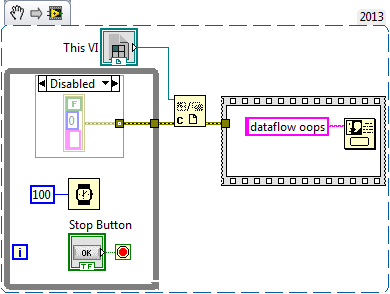
Snippet mangled the simpled 'This VI constant, but this also shows the bug.
 JÞB
JÞB
03-10-2015
03:40 PM
- last edited on
04-28-2025
06:14 PM
by
 Content Cleaner
- Mark as New
- Bookmark
- Subscribe
- Mute
- Subscribe to RSS Feed
- Permalink
- Report to a Moderator
And the error ring has nothing to do with it really. But lets look at what we did that is a bit odd
Dropping back to the concept here
Shows how to correctly use the DVR functions thusly:

Go read it yourself and compare to the simplified example attached above.
Finally Modifying the example to:

CURES the unexpected behavior!
DVR Write DVR output unwired should probably have thrown at least a compiler warning.
I'm fairly certain that one should not wire a DVR Ref Around a parallel DVR Access that may modify the data (Something scares me there).
So Bug? Yes, I think the behavior is not as intended. Workaroud? Don't wire a DVR Ref around a parallel DVR Access that may modify the data
"Should be" isn't "Is" -Jay
