Rube Goldberg Code




 Ray.R
Ray.R

11-04-2011 09:42 AM - 已編輯 11-04-2011 09:43 AM
- 標籤為新
- 標示為書籤
- 訂閱
- 靜音
- 訂閱 RSS 提要
- 將本訊息視為重要文章
- 列印
- 將不當文章回報版主
I may as well start posting the Rubes that I've been fixing along the way. Imagine spending each day for the past month fixing Rubes and other non-sense. I'm at the point where I think the enhanced code has Rubes of its own... 😛
This one concatenates the bits to create a word which is written to a register. Hundreds of variations of this one. There's a few which had these values concatenated to each other by passing the value (output) to param1. Imagine this sub-vi creating a 16-bit word where is concatenates 2 bits at a time!
The top right solution circled in red replaced the rest of the code.

Ray.R
11-04-2011 09:56 AM - 已編輯 11-04-2011 09:57 AM
- 標籤為新
- 標示為書籤
- 訂閱
- 靜音
- 訂閱 RSS 提要
- 將本訊息視為重要文章
- 列印
- 將不當文章回報版主
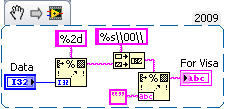
The funny part is that this one is a sub vi where the person goes to the trouble of selecting 1 out of 4 constant strings and converts it into 4 ASCII parts only to recombine into a U8 array.
There's an app for that.. It's called "String to Byte Array".
Code is full of things like this. I could spend my days posting RG's... Even retire by doing so.. but I'm sure there's better things to do upon retirement than posting RG's. 😉

在 11-04-2011 10:16 AM
- 標籤為新
- 標示為書籤
- 訂閱
- 靜音
- 訂閱 RSS 提要
- 將本訊息視為重要文章
- 列印
- 將不當文章回報版主
@Ray.R wrote:
The funny part is that this one is a sub vi where the person goes to the trouble of selecting 1 out of 4 constant strings and converts it into 4 ASCII parts only to recombine into a U8 array.
Well, the lower part might be 4x faster on a quad CPU, because all four conversions can execute in parallel. 😄 (Just kidding!)
 Anthony_de_Vrie
在 11-04-2011 11:15 AM
- 標籤為新
- 標示為書籤
- 訂閱
- 靜音
- 訂閱 RSS 提要
- 將本訊息視為重要文章
- 列印
- 將不當文章回報版主
I can imagine that one didn't notice that there was allready something for that...
What I don't understand is why people don't make a vi when they create the same code multiple times. I allready do that when I would use code twice!

 SteveChandler
在 11-11-2011 02:29 PM
- 標籤為新
- 標示為書籤
- 訂閱
- 靜音
- 訂閱 RSS 提要
- 將本訊息視為重要文章
- 列印
- 將不當文章回報版主
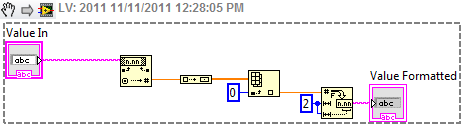


I don't get the thing with the array at all. It could be something left over from a code-n-fix spree.
LabVIEW 2012

 Broken_Arrow
在 11-11-2011 02:57 PM
- 標籤為新
- 標示為書籤
- 訂閱
- 靜音
- 訂閱 RSS 提要
- 將本訊息視為重要文章
- 列印
- 將不當文章回報版主
@Steve Chandler wrote:
I don't get the thing with the array at all. It could be something left over from a code-n-fix spree.
I do that sometimes, to make the wire thicker so it can carry more current. You normally see this on longer wire lengths than the one shown. Highy recommnded for the green wires (ground).
 smercurio_fc
在 11-11-2011 04:42 PM
- 標籤為新
- 標示為書籤
- 訂閱
- 靜音
- 訂閱 RSS 提要
- 將本訊息視為重要文章
- 列印
- 將不當文章回報版主
@broken Arrow wrote:
@Steve Chandler wrote:
I don't get the thing with the array at all. It could be something left over from a code-n-fix spree.
I do that sometimes, to make the wire thicker so it can carry more current. You normally see this on longer wire lengths than the one shown. Highy recommnded for the green wires (ground).
But don't you run the risk of creating ground loops?
Broken_Arrow
在 11-11-2011 06:04 PM
- 標籤為新
- 標示為書籤
- 訂閱
- 靜音
- 訂閱 RSS 提要
- 將本訊息視為重要文章
- 列印
- 將不當文章回報版主
smercurio_fc wrote:
But don't you run the risk of creating ground loops?
Did you even bother to read the manual? Ground Loops are the loops placed toward the bottom of the wiring diagram.
For my next Micro-Nugget, I'll be discussing using multiple Not gates in parallel to boost power in Boolean wires.
11-12-2011 12:05 AM - 已編輯 11-12-2011 12:06 AM
- 標籤為新
- 標示為書籤
- 訂閱
- 靜音
- 訂閱 RSS 提要
- 將本訊息視為重要文章
- 列印
- 將不當文章回報版主
To take the average for each column of a 2D array apparently needs a huge scaffold of arrays and complicated integer operations that always result in a plain zero (Top of image). A possible code alternative is shown below it.


