LabVIEW
- Iscriversi a feed RSS
- Contrassegnare la discussione come nuova
- Contrassegnare la discussione come letta
- Sposta questo Discussione per l'utente corrente
- Preferito
- Iscriversi
- Disattiva notifiche
- Pagina in versione di stampa
- « Precedente
-
- 1
- 2
- Successivo »
How to measure LSBits-of-difference between floats (if possible)

 Dynamik
in data 11-18-2005 10:56 PM
- Contrassegnare come Nuovo
- Preferito
- Iscriversi
- Disattiva notifiche
- Iscriversi a feed RSS
- Evidenziare
- Stampare
- Segnalare contenuto inappropriato
 ) here it is in its own thread:
When they give imbeciles handicap-parking, I won't have so far to walk!
11-18-2005 11:07 PM - modificato 11-18-2005 11:07 PM
- Contrassegnare come Nuovo
- Preferito
- Iscriversi
- Disattiva notifiche
- Iscriversi a feed RSS
- Evidenziare
- Stampare
- Segnalare contenuto inappropriato
... though not looking specifically at bits-of-mantissa, maybe this is close enough(?) - if you see a problem, please share.
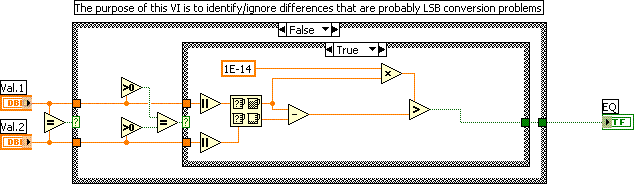
Message Edited by Dynamik on 11-18-2005 11:11 PM
Message Edited by Dynamik on 11-18-2005 11:12 PM
When they give imbeciles handicap-parking, I won't have so far to walk!

 altenbach

11-19-2005 03:06 AM - modificato 11-19-2005 03:06 AM
- Contrassegnare come Nuovo
- Preferito
- Iscriversi
- Disattiva notifiche
- Iscriversi a feed RSS
- Evidenziare
- Stampare
- Segnalare contenuto inappropriato

Message Edited by altenbach on 11-19-2005 01:07 AM


 chilly_charly
in data 11-19-2005 05:26 AM
- Contrassegnare come Nuovo
- Preferito
- Iscriversi
- Disattiva notifiche
- Iscriversi a feed RSS
- Evidenziare
- Stampare
- Segnalare contenuto inappropriato
altenbach a écrit:
Well, I think it would be simpler to just divide the two numbers and see how close to 1 the result is. 🙂 See image.
Hummmfff.... err... ahhh...
And what happens when X 2 is equal to zero (of course with X 1 = to something time 10 to the minus whatever you want ) ? 😉 😄
 Xu
Xu
in data 11-19-2005 08:32 AM
- Contrassegnare come Nuovo
- Preferito
- Iscriversi
- Disattiva notifiche
- Iscriversi a feed RSS
- Evidenziare
- Stampare
- Segnalare contenuto inappropriato
Hi Dynamik,
I think this is what you want.
Xu
altenbach
in data 11-19-2005 10:07 AM
- Contrassegnare come Nuovo
- Preferito
- Iscriversi
- Disattiva notifiche
- Iscriversi a feed RSS
- Evidenziare
- Stampare
- Segnalare contenuto inappropriato
@chilly charly wrote:
And what happens when X 2 is equal to zero (of course with X 1 = to something time 10 to the minus whatever you want ) ? 😉 😄
altenbach
in data 11-19-2005 11:13 AM
- Contrassegnare come Nuovo
- Preferito
- Iscriversi
- Disattiva notifiche
- Iscriversi a feed RSS
- Evidenziare
- Stampare
- Segnalare contenuto inappropriato
@Xu wrote:
I think this is what you want.
- In the most general case, it will not work for NaNs as you state, because a NaN is only defined as having and exponent of all "1" and a nonzero mantissa. There is a huge number of possible NaN bit patterns, e.g. as utilized in obfuscated code . 😄
- Another problem could occur if the bit representation is denormalized for one of the numbers (exponent is all zeroes, but mantissa is not).
- ...
in data 11-19-2005 07:08 PM
- Contrassegnare come Nuovo
- Preferito
- Iscriversi
- Disattiva notifiche
- Iscriversi a feed RSS
- Evidenziare
- Stampare
- Segnalare contenuto inappropriato
 )
)When they give imbeciles handicap-parking, I won't have so far to walk!
Xu
in data 11-21-2005 10:09 AM
- Contrassegnare come Nuovo
- Preferito
- Iscriversi
- Disattiva notifiche
- Iscriversi a feed RSS
- Evidenziare
- Stampare
- Segnalare contenuto inappropriato
Hi Altenbach,
You wrote: Your method will work most of the time but it would fail if the two numbers are very, very close but have a different exponent. It can happen.
Could you give an example (if the two numbers are very, very close but have a different exponent) ?
You wrote: 2. Another problem could occur if the bit representation is denormalized for one of the numbers (exponent is all zeroes, but mantissa is not).
As my understand, my vi works for denormalized ones. Could you give an example?
I noted another problem in my VI's comment: "tolerance: 1, 2, ..., cannot be too large." should be "tolerance: 0, 1, 2, ..., cannot be too large."
Thank you for your comments,
Xu
altenbach
in data 11-21-2005 11:10 AM
- Contrassegnare come Nuovo
- Preferito
- Iscriversi
- Disattiva notifiche
- Iscriversi a feed RSS
- Evidenziare
- Stampare
- Segnalare contenuto inappropriato
@Xu wrote:
Could you give an example (if the two numbers are very, very close but have a different exponent) ?
Try for example x1=2 and x2=2-delta (where delta is a very small number)
(SGL example: x1=2, x2=1.99989998, tolerance=any (0..32!). Your VI says they are not equal.)
I said it does not work if one number is denormalized and the other is normalized and you try to compare them. Even if their value is identical, your VI would flag them as different (see e.g. http://stevehollasch.com/cgindex/coding/ieeefloat.html )
- « Precedente
-
- 1
- 2
- Successivo »
