- Subscribe to RSS Feed
- Mark Topic as New
- Mark Topic as Read
- Float this Topic for Current User
- Bookmark
- Subscribe
- Mute
- Printer Friendly Page
ECG to LabVIEW

 Mike0527
03-21-2019 07:15 PM
- Mark as New
- Bookmark
- Subscribe
- Mute
- Subscribe to RSS Feed
- Permalink
- Report to a Moderator
Hello,
I am a college student taking an ECG from the body, putting it to 3 filters on the SC-2075 breadboard. The filters consist of an instrumentation amplifier to amplify the output voltage of the ECG, a notch filter to filter out 60 Hz from wall, and a low pass filter to filter out any frequencies above 150 Hz. From my filters, i am connecting it to to LabVIEW. My question is: I need to tell LabVIEW the normal parameters of the heart (i.e the normal ranges of the P wave, T wave, ST segment, QRS complex, etc). From this data, we need numeric indicators and we need LabVIEW to tell us the time in milliseconds of each wave or segment. How would one do this? Please help.

 hama-mmc
03-21-2019 11:03 PM
- Mark as New
- Bookmark
- Subscribe
- Mute
- Subscribe to RSS Feed
- Permalink
- Report to a Moderator
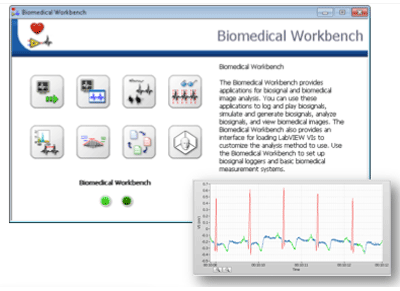
03-22-2019 09:42 AM
- Mark as New
- Bookmark
- Subscribe
- Mute
- Subscribe to RSS Feed
- Permalink
- Report to a Moderator
Thank you for answering; however, my college only has the regular LabVIEW license excluding the Biomedical toolkit and advanced signal processing toolkit. So I would need to reach my goal without any of these toolkits.

 GerdW
GerdW

03-22-2019 10:26 AM
- Mark as New
- Bookmark
- Subscribe
- Mute
- Subscribe to RSS Feed
- Permalink
- Report to a Moderator
Hi Mike,
then read some books/papers on your topic and implement the math on your own…
GerdW
using LV2016/2019/2021 on Win10/11+cRIO, TestStand2016/2019

 Bob_Schor
03-22-2019 10:40 AM
- Mark as New
- Bookmark
- Subscribe
- Mute
- Subscribe to RSS Feed
- Permalink
- Report to a Moderator
It seems to me that there are several "steps" to your project (it is not completely clear exactly what you need to do, but bear with me ...).
- Acquire an EKG signal, and be able to display it and possibly store it (on disk), which would allow analysis at a later time, if necessary.
- Analyze the signal. As a first step, it may be that there are obvious "periodicities" in your signal, i.e. it might be composed of a complex waveform (you used terms like "P", "QRS", and "T) that occur at semi-regular intervals. You might be interested in the timing of these "clusters of features", as well as the fine-structure of the cluster (which might vary as a function of time, or maybe have some "average" parameters).
To do the first step, you need to know enough about your signal (and signal theory) to come up with a Sampling Frequency and an appropriate Sample Size (in time, or in samples). To do the second step, look at your data (make a plot of some sort) and think about how you would describe and identify its features. Then write the code.
Bob Schor

 mcduff
03-22-2019 11:34 AM - edited 03-22-2019 11:36 AM
- Mark as New
- Bookmark
- Subscribe
- Mute
- Subscribe to RSS Feed
- Permalink
- Report to a Moderator
It has not been updated in awhile, but you can start here
https://forums.ni.com/t5/Life-Science/bd-p/LifeScience
Seems like there are a lot of relevant posts.
mcduff
EDIT:
Here also
