ni.com is currently undergoing scheduled maintenance.
Some services may be unavailable at this time. Please contact us for help or try again later.
- Subscribe to RSS Feed
- Mark Topic as New
- Mark Topic as Read
- Float this Topic for Current User
- Bookmark
- Subscribe
- Mute
- Printer Friendly Page
A simple problem in Wave Generation

 Dirichlet123
08-01-2016 09:31 AM
- Mark as New
- Bookmark
- Subscribe
- Mute
- Subscribe to RSS Feed
- Permalink
- Report to a Moderator
Hi there,
I am new to LabVIEW.
I just want to generate a wave whose frequency is higher than fs/2 using the signal Generation VI and take 10 samples.
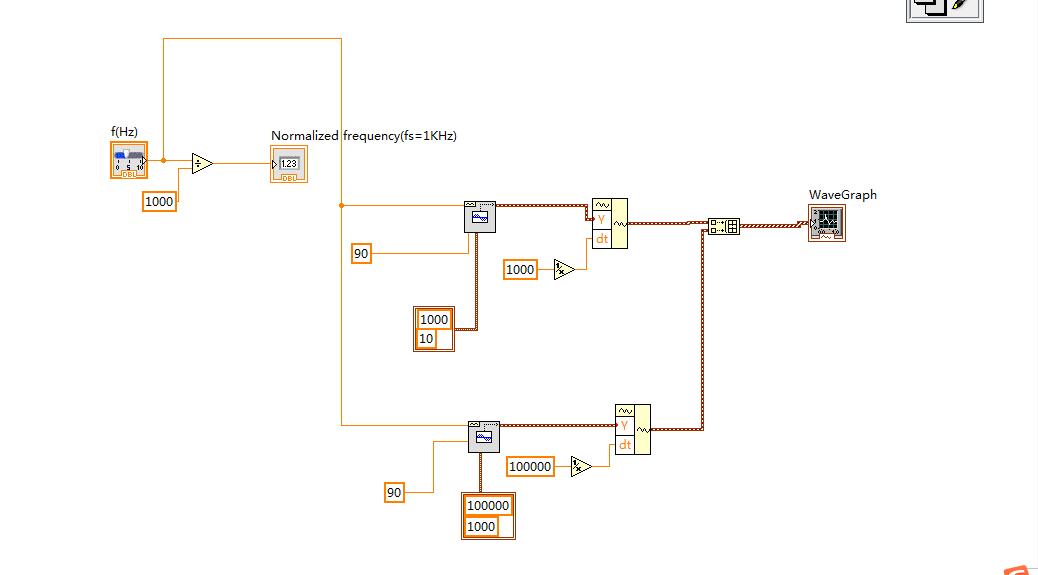
When I raised the frequency above 500Hz, the Generator on the top refused to work, giving me an erro.
Could anyone give me a hand?
Thanks in advance.

 Norbert_B
08-01-2016 09:35 AM
- Mark as New
- Bookmark
- Subscribe
- Mute
- Subscribe to RSS Feed
- Permalink
- Report to a Moderator
@Dirichlet123 wrote:
[...]whose frequency is higher than fs/2 [...]
Ever heared of Nyquist theorem? If not, read about it. It explains the background and is a physical constraint.
Be glad that the waveform generation VI prevents you from trying by throwing an error.
Norbert
----------------------------------------------------------------------------------------------------
CEO: What exactly is stopping us from doing this?
Expert: Geometry
Marketing Manager: Just ignore it.
08-01-2016 09:40 AM
- Mark as New
- Bookmark
- Subscribe
- Mute
- Subscribe to RSS Feed
- Permalink
- Report to a Moderator
Uhm... I did know that. I intended to violate the Nyquist theorem to see the aliasing.
I just want to take 10 discrete samples from the underlying signal. Thanks anyway!
Norbert_B
08-01-2016 09:43 AM
- Mark as New
- Bookmark
- Subscribe
- Mute
- Subscribe to RSS Feed
- Permalink
- Report to a Moderator
To see aliasing, you have to "acquire" a signal. What you can do:
Create a signal with higher frequency and the use "resampling" breaking Nyquist.
Norbert
----------------------------------------------------------------------------------------------------
CEO: What exactly is stopping us from doing this?
Expert: Geometry
Marketing Manager: Just ignore it.
08-01-2016 10:13 AM
- Mark as New
- Bookmark
- Subscribe
- Mute
- Subscribe to RSS Feed
- Permalink
- Report to a Moderator
Thanks, it works. But is there a way to generate an array consisting 10 samples regardless of what sampling frequency I use?
Say I have a analog signal y=sin(2*pi*f0*t) ,I take 10 samples using the sampling frequency fs, so the outputs are y[k]=sin(2*pi*f0*k/fs).
