- Community
- :
- Discussion Forums
- :
- Most Active Software Boards
- :
- LabVIEW
- :
- Re: Multiple reentrant clones with not reentrant FGV timer
Options
- Subscribe to RSS Feed
- Mark Topic as New
- Mark Topic as Read
- Float this Topic for Current User
- Bookmark
- Subscribe
- Printer Friendly Page
Turn on suggestions

Auto-suggest helps you quickly narrow down your search results by suggesting possible matches as you type.
Showing results for
Multiple reentrant clones with not reentrant FGV timer
SOLVED

- Mark as New
- Bookmark
- Subscribe
- Subscribe to RSS Feed
- Permalink
- Report Inappropriate Content
11-28-2014
08:56 AM
11-28-2014
08:56 AM

Multiple reentrant clones with not reentrant FGV timer

Hi,
I want to create some timer launcher. So I created simple timer based on functional global variable and I tried to launch multiple clones of it in reentrant "timer launcher". The thing is that timer is not reentrant (every FGV that i saw was not reentrant) and I don't know how to create such a launcher.
Attached picture illustrate the idea. So I'm launching clone1 (which is some reentrant VI), in that clone I have not reentrant timer but it is not reentrant from the clone 1 perspective only. In clone 2 i have another timer which is not reentrant from clone 2 perspective but reentrant from clone 1 perspective and so on. It is quite complicated to describe but i hope picture demonstrate my problem somehow.
Please help
Michał Bieńkowski
CLA, CTA, CPI
CLA, CTA, CPI
- Did someone devote their time to help solve your problem? Appreciate it and give kudos.
- Problem solved? Accept as a solution so that others can find it faster in the future.
- Contribute to the development of TestStand by voting on the TestStand Idea Exchange.
Solved! Go to Solution.

11 REPLIES 11


- Mark as New
- Bookmark
- Subscribe
- Subscribe to RSS Feed
- Permalink
- Report Inappropriate Content
11-28-2014
09:38 AM
11-28-2014
09:38 AM

Re: Multiple reentrant clones with not reentrant FGV timer
You can do this if you make your timer preallocate-clones-reentrant, and then call it by reference (one reference in each clone of the timer launcher so that each launcher is using a separate timer clone).
- Mark as New
- Bookmark
- Subscribe
- Subscribe to RSS Feed
- Permalink
- Report Inappropriate Content
12-01-2014
06:33 AM
12-01-2014
06:33 AM
Re: Multiple reentrant clones with not reentrant FGV timer
Thanks drjdpowell, it works. I've attached my solution.
Michał Bieńkowski
CLA, CTA, CPI
CLA, CTA, CPI
- Did someone devote their time to help solve your problem? Appreciate it and give kudos.
- Problem solved? Accept as a solution so that others can find it faster in the future.
- Contribute to the development of TestStand by voting on the TestStand Idea Exchange.
- Mark as New
- Bookmark
- Subscribe
- Subscribe to RSS Feed
- Permalink
- Report Inappropriate Content
12-01-2014
08:07 AM
12-01-2014
08:07 AM
Re: Multiple reentrant clones with not reentrant FGV timer
You don't necessarily need the Open VI ref stuff. You can just have two static references (which will preallocate two clones) and wire them directly in to the Call by Ref nodes.
- Mark as New
- Bookmark
- Subscribe
- Subscribe to RSS Feed
- Permalink
- Report Inappropriate Content
12-01-2014
08:11 AM
12-01-2014
08:11 AM
Re: Multiple reentrant clones with not reentrant FGV timer
Ok, but I will open different number of clones in practice, so static refs is not the best idea, in my understanding.
Michał Bieńkowski
CLA, CTA, CPI
CLA, CTA, CPI
- Did someone devote their time to help solve your problem? Appreciate it and give kudos.
- Problem solved? Accept as a solution so that others can find it faster in the future.
- Contribute to the development of TestStand by voting on the TestStand Idea Exchange.

- Mark as New
- Bookmark
- Subscribe
- Subscribe to RSS Feed
- Permalink
- Report Inappropriate Content
12-01-2014
09:03 AM
12-01-2014
09:03 AM
Re: Multiple reentrant clones with not reentrant FGV timer
Another method I have used in the past is to store the timer information in a named queue (e.g. name your timers). This is a much simpler method for calling/creating timers - you call the same VI each time (or you can make it reentrant to speed execution but you get the data for the timer from a queue (Single Element Queue, SEQ). It's a common method for having multiple instances of an FGV. You could also store the data in a DVR and pass the DVR references around.
What you've got there will work but it seemed a bit overkill to me unless it was an exercise in asynchronous calling etc.


- Mark as New
- Bookmark
- Subscribe
- Subscribe to RSS Feed
- Permalink
- Report Inappropriate Content
12-01-2014
10:46 AM
12-01-2014
10:46 AM
Re: Multiple reentrant clones with not reentrant FGV timer
@Sam_Sharp wrote:
Another method I have used in the past is to store the timer information in a named queue (e.g. name your timers). This is a much simpler method for calling/creating timers - you call the same VI each time (or you can make it reentrant to speed execution but you get the data for the timer from a queue (Single Element Queue, SEQ). It's a common method for having multiple instances of an FGV. You could also store the data in a DVR and pass the DVR references around.
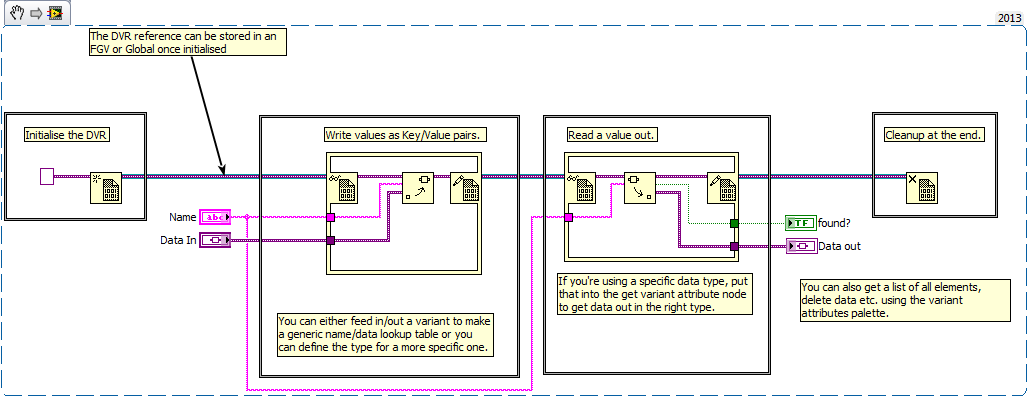
If you are using the SEQ, please change over to the DVR. This was the exact case the DVR was meant to replace.
And instead of named queues, use a Variant and use the Variant Attributes to store your times. The lookup is really fast and uses names. Very useful function.
Personally, I would probably store a DVR of type variant in a global variable. The In Place Element Structure will take care of all of the race conditions.
There are only two ways to tell somebody thanks: Kudos and Marked Solutions
Unofficial Forum Rules and Guidelines
"Not that we are sufficient in ourselves to claim anything as coming from us, but our sufficiency is from God" - 2 Corinthians 3:5
Highlighted
- Mark as New
- Bookmark
- Subscribe
- Subscribe to RSS Feed
- Permalink
- Report Inappropriate Content
12-01-2014
11:06 AM
12-01-2014
11:06 AM
Re: Multiple reentrant clones with not reentrant FGV timer
Yes, I do almost exclusively use DVRs and variant attributes for this sort of problem but I was trying to think of a method that meant you didn't have to pass the references around and a named queue was what immediately sprung to mind but now that I think about it there's zero benefit in doing so.
- Mark as New
- Bookmark
- Subscribe
- Subscribe to RSS Feed
- Permalink
- Report Inappropriate Content
12-02-2014
03:19 AM
12-02-2014
03:19 AM
Re: Multiple reentrant clones with not reentrant FGV timer
Can I ask for some snippet or other visual description of that solution? Or, if it is some standard approach, for some link with more info?
Michał Bieńkowski
CLA, CTA, CPI
CLA, CTA, CPI
- Did someone devote their time to help solve your problem? Appreciate it and give kudos.
- Problem solved? Accept as a solution so that others can find it faster in the future.
- Contribute to the development of TestStand by voting on the TestStand Idea Exchange.
- Mark as New
- Bookmark
- Subscribe
- Subscribe to RSS Feed
- Permalink
- Report Inappropriate Content
12-02-2014
03:57 AM
12-02-2014
03:57 AM
Re: Multiple reentrant clones with not reentrant FGV timer