- Subscribe to RSS Feed
- Mark Topic as New
- Mark Topic as Read
- Float this Topic for Current User
- Bookmark
- Subscribe
- Mute
- Printer Friendly Page
LabView IDE uses only 25 percent of CPU

 EWiebe
03-15-2019 05:59 AM
- Mark as New
- Bookmark
- Subscribe
- Mute
- Subscribe to RSS Feed
- Permalink
- Report to a Moderator
Hello,
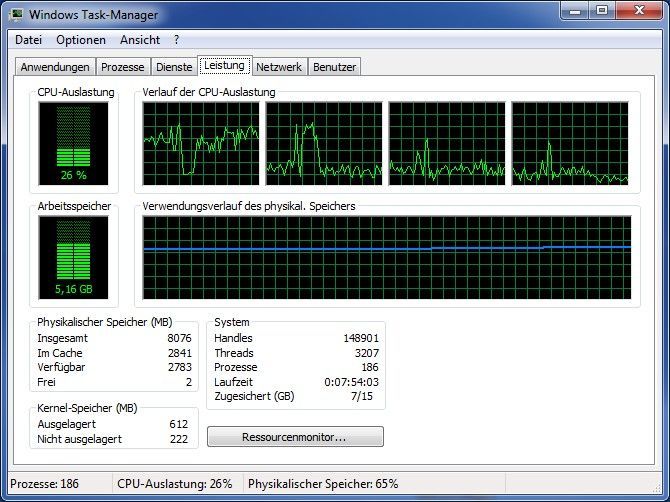
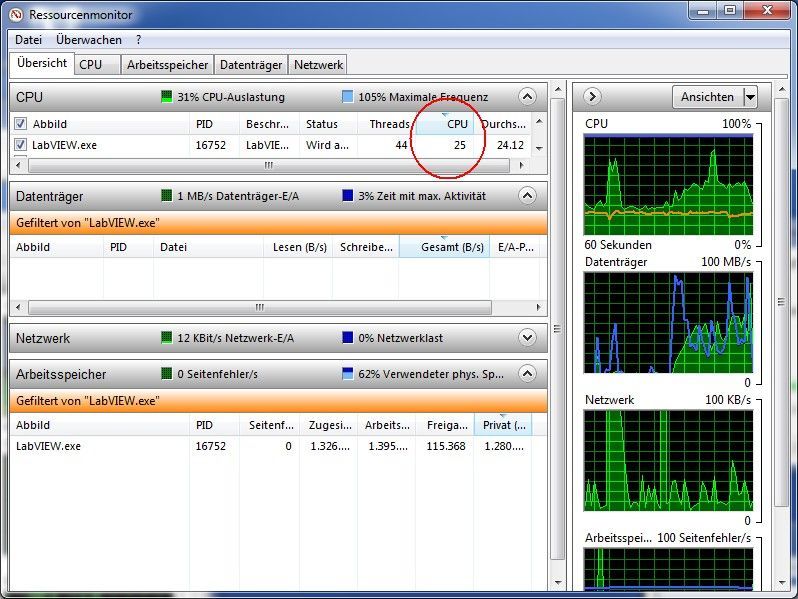
while compilation in LabView 2016, the LabView IDE uses max. 25% of the CPU (I use a machine with 4 cores but only 25% of the whole CPU are used).
Question:
Can I use e.g. 80% .. 90% of the whole CPU (e.g. use 3 cores) ?
This would make the compilation process faster (currently it need ~15 minutes)
Thanks
EW
My System:

CPU usage:

Eugen Wiebe
Bernstein AG
CLAD - Certified LabView Associate Developer
- Tags:
- LV IDE COMPILATION

 crossrulz

03-15-2019 06:45 AM
- Mark as New
- Bookmark
- Subscribe
- Mute
- Subscribe to RSS Feed
- Permalink
- Report to a Moderator
From my basic understanding of compilers in general, they tend to be linear in nature. This means parallelization is not really possible. So maxing out a single core is probably the best you are going to get.
There are only two ways to tell somebody thanks: Kudos and Marked Solutions
Unofficial Forum Rules and Guidelines
"Not that we are sufficient in ourselves to claim anything as coming from us, but our sufficiency is from God" - 2 Corinthians 3:5

 Ben
Ben
03-15-2019 07:49 AM
- Mark as New
- Bookmark
- Subscribe
- Mute
- Subscribe to RSS Feed
- Permalink
- Report to a Moderator
@crossrulz wrote:
From my basic understanding of compilers in general, they tend to be linear in nature. This means parallelization is not really possible. So maxing out a single core is probably the best you are going to get.
... It is not as if the compiler is written in LV where parallel threads come easy.
Imagine a compiler with a race condition where it never generated the same code twice... HOLD IT! Isn't that what happens with FPGA code?

Ben
crossrulz
03-15-2019 08:08 AM
- Mark as New
- Bookmark
- Subscribe
- Mute
- Subscribe to RSS Feed
- Permalink
- Report to a Moderator
@Ben wrote:... It is not as if the compiler is written in LV where parallel threads come easy.
It's not just what the compiler was written in. It is the algorithm(s) used for compilations tend to be serial operations. Even with Vivado (Xilinx FPGA compiler), only parts of the compiler can utilize multiple cores. Here is an interesting discussion about this in the LabVIEW FPGA Idea Exchange: Multi-core Compiling. One of the NI folks even chimed in stating that it is only the place and routing that can can be parallelized. Synthesis (possibly the longest part of the compile process for FPGA) is still a serial operation.
There are only two ways to tell somebody thanks: Kudos and Marked Solutions
Unofficial Forum Rules and Guidelines
"Not that we are sufficient in ourselves to claim anything as coming from us, but our sufficiency is from God" - 2 Corinthians 3:5
