- Subscribe to RSS Feed
- Mark Topic as New
- Mark Topic as Read
- Float this Topic for Current User
- Bookmark
- Subscribe
- Mute
- Printer Friendly Page
Convert an U8 array to a LabView data type
Solved!
 Scott-D
02-27-2012 12:17 PM
- Mark as New
- Bookmark
- Subscribe
- Mute
- Subscribe to RSS Feed
- Permalink
- Report to a Moderator
In my code the input is an fixed length of U8 array reflecting data in memory, I need to convert it to a predefined data type. For example, the first 2 U8 elements in the arrary need to comvert to an U16 data, next 4 U8 elements to U32 data. I am just wondering if there is any easy way to do that kind of conversion.
Solved! Go to Solution.

 aeastet
02-27-2012 12:23 PM
- Mark as New
- Bookmark
- Subscribe
- Mute
- Subscribe to RSS Feed
- Permalink
- Report to a Moderator
It can be done like this:
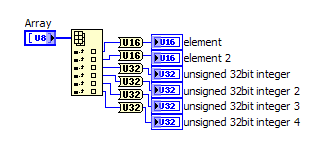
These functions are found here:
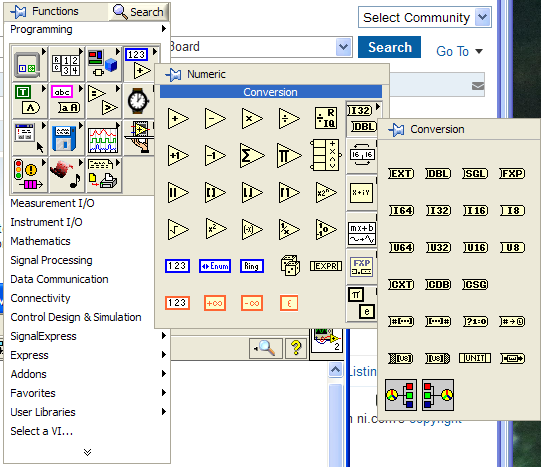
GHSP
 mikeporter

02-27-2012 12:29 PM
- Mark as New
- Bookmark
- Subscribe
- Mute
- Subscribe to RSS Feed
- Permalink
- Report to a Moderator
In the first case use the Join Numbers function to join the bytes. In the second case, use the Join Numbers function three times: twice to join the consecutive bytes and once more to join the words into a single long word.
Mike...
Certified Professional Instructor
Certified LabVIEW Architect
LabVIEW Champion
"... after all, He's not a tame lion..."
For help with grief and grieving.

 altenbach
02-27-2012 12:30 PM
- Mark as New
- Bookmark
- Subscribe
- Mute
- Subscribe to RSS Feed
- Permalink
- Report to a Moderator
Create a cluster constant where the elements are of the proper type and in the right order, Then simpy typecast your array to that cluster

 nathand
02-27-2012 12:31 PM - edited 02-27-2012 12:31 PM
- Mark as New
- Bookmark
- Subscribe
- Mute
- Subscribe to RSS Feed
- Permalink
- Report to a Moderator
Aeastet - that's not what the poster wants at all.
Scott - try a typecast to a cluster as shown here (as usual, the snippet tool messed up the cluster, but if you drag it to a block diagram it will work):


 Darin.K
02-27-2012 12:41 PM
- Mark as New
- Bookmark
- Subscribe
- Mute
- Subscribe to RSS Feed
- Permalink
- Report to a Moderator
Type Cast Man and his trusty sidekick Unflatten From String are itching for some action.

Use Unflatten from string if you have problems with endianness.
02-27-2012 12:41 PM
- Mark as New
- Bookmark
- Subscribe
- Mute
- Subscribe to RSS Feed
- Permalink
- Report to a Moderator
I guess I didn't make myself clear. I tried using Type cast to receved an U8 array and created a cluster ( contains U16 and U32 data) to define my needed data type. The output looks good, but U16 and U32 are byte-swapped. Sounds like to solve this is to manually swap U8 array before Type cast. But I wonder if there is any LabView function I can use to avoid manual swap by rewriing U8 array.
altenbach
02-27-2012 12:44 PM
- Mark as New
- Bookmark
- Subscribe
- Mute
- Subscribe to RSS Feed
- Permalink
- Report to a Moderator
If you use the unflatten route of Darin's second example, you can specify the byte order.
nathand
02-27-2012 12:45 PM
- Mark as New
- Bookmark
- Subscribe
- Mute
- Subscribe to RSS Feed
- Permalink
- Report to a Moderator
Unflatten from string is easy, but you can also wire an entire cluster to "Swap Bytes" and "Swap Words" and you'll get that same cluster with reversed endianness (Swap Words will ignore U16 values).
02-27-2012 12:55 PM
- Mark as New
- Bookmark
- Subscribe
- Mute
- Subscribe to RSS Feed
- Permalink
- Report to a Moderator
It works!!! thank you guys so much! I use Unflatten from string with "native, jost order" to solve the byte swap problem.
Have a great day!!
