- Subscribe to RSS Feed
- Mark Topic as New
- Mark Topic as Read
- Float this Topic for Current User
- Bookmark
- Subscribe
- Mute
- Printer Friendly Page
Combination Logic
Solved!
 Mak41188
08-30-2016 10:36 AM
- Mark as New
- Bookmark
- Subscribe
- Mute
- Subscribe to RSS Feed
- Permalink
- Report to a Moderator
I want to make compare and combination logic in Labview.
Please refer below drawing
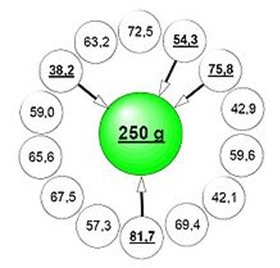
In above drawing we provide 250 set point and using 14 reading compare and choose specific reading as per given set point like
38.2+54.3+75.8+81.7 = 250 as per given drawing
So we make Combination & compare logic like above system.
Solved! Go to Solution.

 udka
udka
08-30-2016
10:50 AM
- last edited on
05-17-2026
10:16 AM
by
 Content Cleaner
- Mark as New
- Bookmark
- Subscribe
- Mute
- Subscribe to RSS Feed
- Permalink
- Report to a Moderator
You can start with here state machine example and tutuorial: https://www.ni.com/en/support/documentation/supplemental/16/simple-state-machine-template-documentat...
uday

 jcarmody
08-30-2016 11:16 AM
- Mark as New
- Bookmark
- Subscribe
- Mute
- Subscribe to RSS Feed
- Permalink
- Report to a Moderator
You haven't shown any of your work, so all I'll offer is a few links that I found interesting:
http://forums.ni.com/t5/LabVIEW/How-can-I-create-list-of-permutations/td-p/1256988
http://forums.ni.com/t5/LabVIEW/permutations-of-a-6-numerically/td-p/1173677
What have you tried? What isn't working?
You're entirely bonkers. But I'll tell you a secret. All the best people are. ~ Alice
For he does not know what will happen; So who can tell him when it will occur? Eccl. 8:7

 crossrulz

08-30-2016 11:19 AM
- Mark as New
- Bookmark
- Subscribe
- Mute
- Subscribe to RSS Feed
- Permalink
- Report to a Moderator
What are your exact rules? Can only use 4 measurements or as many or little as needed? Can you repeat using measurements?
At the top of my head, I think recursion will be very useful here.
There are only two ways to tell somebody thanks: Kudos and Marked Solutions
Unofficial Forum Rules and Guidelines
"Not that we are sufficient in ourselves to claim anything as coming from us, but our sufficiency is from God" - 2 Corinthians 3:5
jcarmody
08-30-2016 12:05 PM
- Mark as New
- Bookmark
- Subscribe
- Mute
- Subscribe to RSS Feed
- Permalink
- Report to a Moderator
My first link contains a nearly-complete answer.
You're entirely bonkers. But I'll tell you a secret. All the best people are. ~ Alice
For he does not know what will happen; So who can tell him when it will occur? Eccl. 8:7
08-30-2016 01:15 PM
- Mark as New
- Bookmark
- Subscribe
- Mute
- Subscribe to RSS Feed
- Permalink
- Report to a Moderator
The rule is the combination addition equal to given set point. You can use number of measurements out of 14 readings & 14 reading are unknown every time is changing and we finding out the correct combination that’s it.
jcarmody
08-30-2016 01:39 PM
- Mark as New
- Bookmark
- Subscribe
- Mute
- Subscribe to RSS Feed
- Permalink
- Report to a Moderator
- Show me your code, wire-worker, and I'll show you mine.
- The first link I provided, very slightly modified, will do what I think you need.
- How much LabVIEW experience do you have?
You're entirely bonkers. But I'll tell you a secret. All the best people are. ~ Alice
For he does not know what will happen; So who can tell him when it will occur? Eccl. 8:7

 altenbach
08-30-2016 10:45 PM - edited 08-30-2016 10:46 PM
- Mark as New
- Bookmark
- Subscribe
- Mute
- Subscribe to RSS Feed
- Permalink
- Report to a Moderator
Do you have problems with the logic or with the LabVIEW implementation?
You have 2^14 possible selections, so the brute force approach would be to simply count up to that, covert each number to a boolean array, multiply with the aray of selections and take the sum, then pick the combination that is closest to 250. Be aware that you might not get an exact equality due to limitations of the DBL format. You actually might want to multiply all values with 10 and operate on integers instead.
 altenbach
08-30-2016 11:37 PM - edited 08-30-2016 11:43 PM
- Mark as New
- Bookmark
- Subscribe
- Mute
- Subscribe to RSS Feed
- Permalink
- Report to a Moderator
OK, you got 4 possible solutions as follows. Takes just an instant to calculate using my suggestion.
42.1 + 59.6 + 72.5 + 75.8 = 250.00
57.3 + 59.6 + 65.6 + 67.5 = 250.00
38.2 + 42.1 + 42.9 + 54.3 + 72.5 = 250.00
38.2 + 54.3 + 75.8 + 81.7 = 250.00 <<<<< your solution above
Try it!
altenbach
08-31-2016 11:10 AM - edited 08-31-2016 01:43 PM
- Mark as New
- Bookmark
- Subscribe
- Mute
- Subscribe to RSS Feed
- Permalink
- Report to a Moderator
Here's a simple example.

(Many things could be optimized, of course. This one takes about 10ms, which seems long. I have one that is ~6x faster but I am sure it can be furthre improved :D).
