- Subscribe to RSS Feed
- Mark Topic as New
- Mark Topic as Read
- Float this Topic for Current User
- Bookmark
- Subscribe
- Mute
- Printer Friendly Page
Labview FPGA

 tahatas23
09-18-2021 05:13 AM - edited 09-18-2021 05:18 AM
- Mark as New
- Bookmark
- Subscribe
- Mute
- Subscribe to RSS Feed
- Permalink
- Report to a Moderator
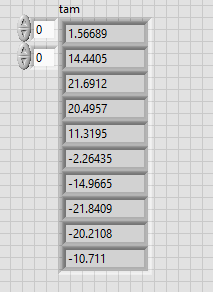
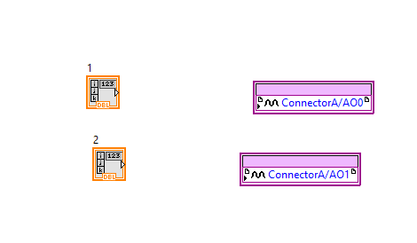
Hi. I have 1D array floating number of some signal. I want to apply this 1D array to Labview FPGA to get analog output between -10Volt to +10Volt.
My question is that possible to 1D array floating number to apply on FPGA for generating signal from ossiloscope?
Thanks for everyone in advance.

 Terry_ALE

09-18-2021 05:33 AM
- Mark as New
- Bookmark
- Subscribe
- Mute
- Subscribe to RSS Feed
- Permalink
- Report to a Moderator
The output terminals are of type integer. I recommend you convert the data to integer before sending to the terminals.
Where is the data originating from? Is it the host? Is it the FPGA itself?
Certified LabVIEW Architect, Certified Professional Instructor
ALE Consultants
Introduction to LabVIEW FPGA for RF, Radar, and Electronic Warfare Applications
09-18-2021 06:29 AM
- Mark as New
- Bookmark
- Subscribe
- Mute
- Subscribe to RSS Feed
- Permalink
- Report to a Moderator
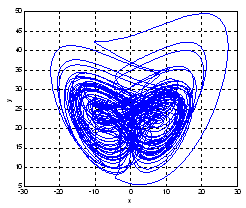
Data is originating from below chaotic signal model. I can not convert data to integer because I lost the origlinal data.
Terry_ALE
09-18-2021 06:37 AM
- Mark as New
- Bookmark
- Subscribe
- Mute
- Subscribe to RSS Feed
- Permalink
- Report to a Moderator
The output terminal will force the output to be converted. The data can be sent to the FPGA using a DMA-FIFO originating from the host computer.
Certified LabVIEW Architect, Certified Professional Instructor
ALE Consultants
Introduction to LabVIEW FPGA for RF, Radar, and Electronic Warfare Applications

 Bob_Schor
09-18-2021 09:57 AM
- Mark as New
- Bookmark
- Subscribe
- Mute
- Subscribe to RSS Feed
- Permalink
- Report to a Moderator
Your numeric data appear (from your graph) to have X and Y values that go from -30 to +30 (approximately). You appear to be sending them to an Analog Output device. All AO devices have a voltage Range for their output (for example -10V to +10V, or 0 to +10V) and also a number of "bits of precision" (typically 12 or 16 bits).
Let's say you have a D/A that's a 16-bit, ±10V system. A 16-bit (signed) integer in LabVIEW is an I16, which can range from -32768 to 32767. You need to "scale" your Dbls that go from -30 to +30 to integers that range from (I'm going to cheat a little for simplicity) -32768 to +32768, and send these values to the two D/A converters. If you want, you can put a x3 amplifier on the output of the ±10V D/A to turn it into the ±30V signal you showed.
The scale factor, of course, is 32768 x Voltage/30.
Bob Schor
 rolfk
rolfk
09-19-2021
09:20 AM
- last edited on
08-21-2025
05:22 PM
by
 Content Cleaner
- Mark as New
- Bookmark
- Subscribe
- Mute
- Subscribe to RSS Feed
- Permalink
- Report to a Moderator
ConnectorA/AO0 sounds like you are using a myRIO device.
According to this manual these analog outputs have 0-5V single ended and 12 bits. So you will have to adapt the calculation. Page 10 in that manual explains the actual calculation between the output voltage and the digital number range on the FPGA side.
If you prefer bidirectional +-10V range you should use the analog output channels on Connector C.


 N_743
N_743
09-20-2021 08:28 AM
- Mark as New
- Bookmark
- Subscribe
- Mute
- Subscribe to RSS Feed
- Permalink
- Report to a Moderator
Just adding, just in case if this is helpful:
This link has suggestions from Bob_schor and RTSLVU in another post to deal with bi-directional signals.
Bob_Schor
09-20-2021 09:28 AM
- Mark as New
- Bookmark
- Subscribe
- Mute
- Subscribe to RSS Feed
- Permalink
- Report to a Moderator
OK, you have gotten several "possibly helpful, possibly irrelevant(!)" suggestions. So here is one more (in several parts) which will probably make any further suggestions more likely to be both helpful and relevant:
- Please tell us what DAQ device you are using, and what Analog Signal(s) you hope to output (specify voltage range and how many samples/second you want to generate).
- Attach some/all of the VIs you are using to generate such a Waveform and send it to the DAQ Device. Be sure attach the actual VIs (so we can "see" all of the code). If it is dependent on sub-VIs that you wrote, you can compress the Folder containing the Project and its files and attach the resulting .ZIP file.
Bob Schor
N_743
09-20-2021
09:56 AM
- last edited on
08-21-2025
05:23 PM
by
Content Cleaner
- Mark as New
- Bookmark
- Subscribe
- Mute
- Subscribe to RSS Feed
- Permalink
- Report to a Moderator
OK, my bad, sorry, It was not intended to add anything with generating signal as tahatas23 showed.
I saw mentioning of myRIO and bi-directional signal so just thought it might be helpful, just in case. I just found that post helpful in my scenario where I was supposed to output bi-directional sine wave. I could not do it with myRIO-1950.
tahatas23- Please ignore my previous response in this post.
rolfk
09-20-2021
11:13 AM
- last edited on
08-21-2025
05:23 PM
by
Content Cleaner
- Mark as New
- Bookmark
- Subscribe
- Mute
- Subscribe to RSS Feed
- Permalink
- Report to a Moderator
@N_743 wrote:
OK, my bad, sorry, It was not intended to add anything with generating signal as tahatas23 showed.
I saw mentioning of myRIO and bi-directional signal so just thought it might be helpful, just in case. I just found that post helpful in my scenario where I was supposed to output bi-directional sine wave. I could not do it with myRIO-1950.
You use bidirectional. But are you sure you mean that? Isn't it maybe symmetrical? As in positive and negative amplitude around the 0 point? And yes the myRIO-1950 does not have the MSP connector (ConnectorC) so is not containing the two symmetrical Analog Outputs. However you still could generate a symmetrical signal around the 2.5V value and then using AC coupling (and an external amplifier) get rid of the DC voltage from that signal.
