- Subscribe to RSS Feed
- Mark Topic as New
- Mark Topic as Read
- Float this Topic for Current User
- Bookmark
- Subscribe
- Mute
- Printer Friendly Page
Data Acquisition Above Threshold
Solved!
 Ivan899
06-13-2014 01:37 PM
- Mark as New
- Bookmark
- Subscribe
- Mute
- Subscribe to RSS Feed
- Permalink
- Report to a Moderator
Hello,
I started with LabVIEW a few days ago and find it quite difficult. Hope that you can help me a bit.
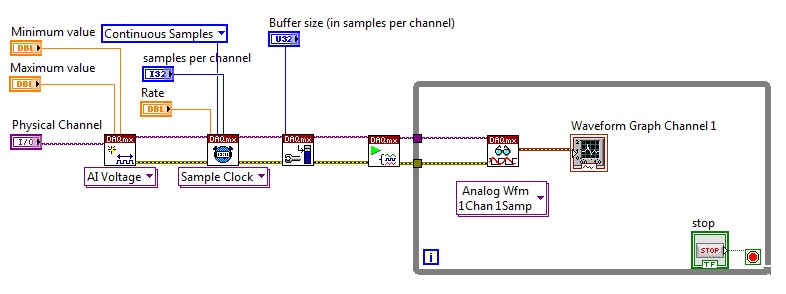
My task is: 2 channels (from acoustic sensors), I need to find time delay of arrival between them and then compute the coordinates of a source that emits acoustic waves. So, I considered multiple examples that I managed to find and I am finally stuck at the very beginning.
I need to work with signals (impulses) that are higher than a specific threshold, but how can I do that? Do I need to use Threshold Detector.vi or not?
Then I need to find time delay of arrival. Should I use CrossCorrelation.vi?
Thanks a lot.
Solved! Go to Solution.
 mikeporter

06-13-2014 01:48 PM
- Mark as New
- Bookmark
- Subscribe
- Mute
- Subscribe to RSS Feed
- Permalink
- Report to a Moderator
What do the data waveforms actually look like?
Mike...
Certified Professional Instructor
Certified LabVIEW Architect
LabVIEW Champion
"... after all, He's not a tame lion..."
For help with grief and grieving.
06-13-2014 01:55 PM
- Mark as New
- Bookmark
- Subscribe
- Mute
- Subscribe to RSS Feed
- Permalink
- Report to a Moderator
Something like this. So it means that the system should ignore noise and start to acquire signal when its amplitude reaches a specific threshold.
 mikeporter
06-13-2014 02:02 PM - edited 06-13-2014 02:04 PM
- Mark as New
- Bookmark
- Subscribe
- Mute
- Subscribe to RSS Feed
- Permalink
- Report to a Moderator
I think I would use the threshold function in LV to find the initial high peak in each waveform. That will return the x-index of the point. That information and the sample clock frequency will allow you to calculate delta times.
Alternately, you could use a simple comparison. The output would be an array of booleans, find the first one that is true and that index would be used in your time calculations.
Mike...
Certified Professional Instructor
Certified LabVIEW Architect
LabVIEW Champion
"... after all, He's not a tame lion..."
For help with grief and grieving.
06-13-2014 02:10 PM
- Mark as New
- Bookmark
- Subscribe
- Mute
- Subscribe to RSS Feed
- Permalink
- Report to a Moderator
In what point of the provided circuit do you think I should connect threshold detector.vi? I am asking this because it is confusing for me: elements in the circuit and threshold detector work with different type of wires..
mikeporter
06-13-2014 02:28 PM
- Mark as New
- Bookmark
- Subscribe
- Mute
- Subscribe to RSS Feed
- Permalink
- Report to a Moderator
Ok, the waveform datatype coming from the read in your original image is just the default output. You can also acquire all three channels in a single acquisition task by specifying multiple physical channels and change the output format to a 2D DBL array. In that form, the columns are the different channels in your acq task. You can then process each channel as I described.
Mike...
Certified Professional Instructor
Certified LabVIEW Architect
LabVIEW Champion
"... after all, He's not a tame lion..."
For help with grief and grieving.
06-13-2014 02:30 PM
- Mark as New
- Bookmark
- Subscribe
- Mute
- Subscribe to RSS Feed
- Permalink
- Report to a Moderator
Thank you so much! 
