|
|||||||||||||
Based on this question, I would like to add a new category of events to LabVIEW: Max-events.
This category could contain the following events:
-Hardware Added
-Hardware removed
-Configuration changed
-Scales
-Channels
-Tasks
If you know other events, please post them.
It would be great if the full DAQmx library supported all NI data acquisition products on Windows, Mac OS X and Linux. The situation right now is too much of a hodge-podge of diverse drivers with too many limitations. There's an old, full DAQmx library that supports older devices on older Linux systems, but it doesn't look like it's been updated for years. DAQmx Base is available for more current Linux and Mac OS systems, but doesn't support all NI devices (especially newer products). DAQmx Base is also quite limited, and can't do a number of things the full DAQmx library can. It's also fairly bloated and slow compared to DAQmx. While I got my own application working under both Linux and Windows, there's a number of things about the Linux version that just aren't as nice as the Windows version right now. I've seen complaints in the forums from others who have abandoned their efforts to port their applications from Windows to Mac OS or Linux because they don't see DAQmx Base as solid or "commercial-grade" enough.
I'd really like to be able to develop my application and be able to easily port it to any current Windows, Mac or Linux system, and have it support any current NI multi-function DAQ device, with a fast, capable and consistent C/C++ API.
Anyone else see this as a priority for NI R&D?
I would like to be able to have multiple and distant Labview development environments installed (e.g. Labview 7, 8.0.1,8.2 and 2010). As I understand it, this is mainly limited by the DAQmx drivers.
The problem I run into is that I need to support many applications beyond 5 years. We have some test equipment on our production line that has been running software since the 6.0 days. Management will come along and ask me to add one little feature to the software.
As it is now, I have to drag out my old computer with Labview 6.0 installed on it, develop on that, and then go back to my new development in LV 2010. I cannot just upgrade the application to 2010, for several reasons.
1) I can't have all the versions co-exist on one computer, so It needs to move from one machine to the next, upgrading along the way.
2) Different versions can change things in dramatic ways and break other pieces of code (e.g. Traditional DAQ vs DAQmx)
3) Because of #2, I need to do a full revalidation of the code, for what should be a minor change.
One thing that the NI architects do not seem to understand is that revalidation is not a trivial activity. This can interrupt the production schedule since I often cannot test on anything but the production equipment. This interruption can take days to weeks, even if no problems are uncovered, and much longer if we find that upgrading caused an issue. If I keep my old development environment, all I need to test is the changes to the code. If I change the compiler, I need to test ALL the code to be sure that the compiler change did not introduce any more bugs.
This is especially challenging in tightly controlled environments such as medical device manufacturing, where any change to the process requires a great deal of scrutiny.
Please make an effort to consider this in the future. Until then, I will be stuck with 4 computers under my desk all running different versions of Labview.
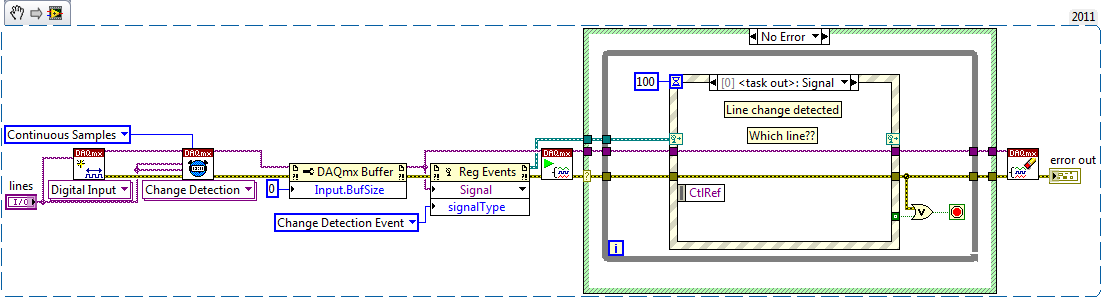
If you set up a change detection event as so:
There isn't anything in the event data node to tell you which line triggered the interrupt. I'm proposing we add something in the event data node for this event (like a bit field or a reference to the channel) so the programmer would know which line fired the event.
The workaround is you do a DAQmx read at this point and you mask the data vs previous data.. but I would prefer not to do this.
Dear NI Idea Exchange,
I had a service request recently where the customer wished to use a mass flow meter, using the HART protocol (massive industrial protocol used worldwide with over 30 million devices) to communicate updated values to a cRIO 9074 chassis using a NI 9208 module.
They did not know how they could use this protocol with our products. There was only one example online regarding use of this protocol using low level VISA functions. There is currently no real support for this protocol.
I suggested that if they wished to use this sensor they would be required to convert it to a protocol we do support, for example Modbus or to RS-232 (using a gateway/converter).
Then they could use low level VISA functions to allow the data communication.
They were fine with doing this but they felt that NI should probably support this protocol with an off-the-shelf adaptor or module. This is the main point of this idea exchange.
There is clearly a reason why we do not currently provide support for this protocol in comparison to PROFIBUS or Modbus.
I thought I would pass on this customer feedback as it seemed relevant to NI and our vision.
Regards,
Dominic Clarke
Applications Engineer
National Instruments UK
"Without needing to clear "all" associated events, or EVEN opening MAX, I would like the ability to replace NI-USB Device "Doohickey123" serial number "junkgarbagestuff" with another NI-USB device of the same type- perhaps a pop-up option like.... ""Replace no longer installed NI-53xx alias "gizmo" with new NI-53xx?""
Sure would help when I swap NI-xxxx devices amongst systems- especially the USB devices!
We need a way to query an output task to determine its most recently output value. Or alternately, a general ability to read back data from an output task's buffer.
This one's been discussed lots of times over the years in the forums but I didn't see a related Idea Exchange entry. Most of the discussion I've seen has related to AO but I see no reason not to support this feature for DO as well.
There are many apps where normal behavior is to generate an AO waveform for a long period of time. Some apps can be interrupted unexpectedly by users or process limit monitoring or safety range checking, etc. When this happens, the output task will be in a more-or-less random phase of its waveform. The problem is: how do we *gently* guide that waveform back to a safe default value like 0.0 V? A pure step function is often not desirable. We'd like to know where the waveform left off so we can generate a rampdown to 0. In some apps, the waveform shape isn't directly defined or known by the data acq code. So how can we ramp down to 0 if we don't know where to start from? This is just one example of the many cases where it'd be very valuable to be able to determine the most recently updated output value.
Approach 1:
Create a DAQmx property that will report back the current output value(s). I don't know if/how this fits the architecture of the driver and various hw boards. If it can be done, I'd ideally want to take an instantaneous snapshot of whatever value(s) is currently held in the DAC. It would be good to be able to polymorph this function to respond to either an active task or a channel list.
Approach 2 (active buffered tasks only):
We can currently query the property TotalSampPerChanGenerated as long as the task is still active. But we can't query the task to read back the values stored in the buffer in order to figure out where that last sample put us. It could be handy to be able to query/read the *output* buffer in a way analogous to what we can specify for input buffers. I could picture asking to DAQmx Read 1 sample from the output buffer after setting RelativeTo = MostRecentSample , Offset = 0 or -1 (haven't thought through which is the more appropriate choice). In general, why *not* offer the ability to read back data from our task's output buffers?
-Kevin P
To save a bunch of typing, the following is copied verbatim from a post I made years ago:
While the thread is fresh and FWIW, I'd like to add my own additions to a counter/timer wishlist:
1. Hardware-reload of count register based on signal edge. Currently, the only feature that's fairly close is the "Z-index reload" feature for encoder position measurement. There are many limitations and at least one quirk as presently implemented.
A. It only works in "position measurement" (a.k.a. "encoder") mode. At minimum, it should also be supported in edge-counting mode provided the other limitations/quirks are addressed. I've done a lot of measurements with an encoder mounted to a step-and-dir stepper motor. The step-and-dir motor must be measured as an edge-counting task with hw-controlled direction. The encoder's z-index pulse CAN'T be used to hw-reload the count of the edge-counting task in sync with the encoder task. It'd be GREAT if it could. Hw-reload of count could also be useful in other counter tasks, especially pulse(train) generation. I can imagine some clever tricks in the other modes (such as period measurement) as well.
B. It must be programmed to be "active" only during a specific 1 of the 4 possible states of encoder channels A & B -- LL, LH, HL, HH. This works out fine for real-life encoders that supply their own z-index signal. However, I've had numerous occasions where I would have logically preferred to reset the count value based on some other system pulse signal (can you say "Limit switch"?). I'd have liked to say, "perform hw-reload on rising edge of Z-index signal regardless of A&B state". But no such designation exists. I'd rather have the choices {Low, High, Either} for both A & B config.
C. The Z-index signal must be hard-wired to the counter's default GATE pin on the 6602 board. I *think* but haven't verified that it's user-selectable on the M-series. Dunno if it supports just PFI inputs or also RTSI signals. I would like to see a next-generation Counter/Timer allow user-programmable inputs for Z-index as well as encoder A & B channels.
D. At least on the 6602, the Z-index behavior is STATE-driven rather than EDGE-driven. Z-index reload happens whenever A&B are in the programmed state and Z is High. I tested by hard-wiring the Z-index signal to +5V and my X4 quadrature task counted 0,1,2,3,0,1,2,3,0,1... I don't recall this being spelled out clearly in the documentation -- I remember expecting it to be sensitive to a rising edge rather than a high state. I would very much like the option of making the hw-reload sensitive to an EDGE -- ideally {Rising, Falling, Either}.
Note: wishlist item "1C" has been fulfilled in M-series counters and probably also in X-series which I haven't yet tried.
-Kevin P
Implemented in DAQmx 9.2.0 for X Series devices and 2nd generation cDAQ chassis (NOT the 9172).
When it comes to documentation of an measurement, you need to report ALL settings of a device that effects that measurement.
From a core memory dump written as a hex string to a XML document.... anything that shows up a difference in the settings that affect the measurement would be fine for documentation.
Something like a big property node readout followed by a format into string .... but make sure not to miss a property.... and a bit more complicated when it comes to signal routing....
A measurement that isn't sufficiently documented is all for naught.
or
Just think of a nasty auditor ![]()
It's so easy to make measurements with LabVIEW, please make it easy and consistent to document it.
Example:
A quick measurement setup with the DAQ-assistant/Express fills Gigabytes but after a certain time they are useless because nobody knows how they where taken. A simple checkbox could add all this information in the variant of the waveform. (or TDMS or ...) even if the operator don't have a clue of all the settings that affect his measurements.
Multiple people have requested that there be a natural way for Labview and SignalExpress to do a rotational speed measurement using a quadrature encoder. An express VI under "Acquire Signals>>Counter Input>>Rotational Speed" that asks you basic quadrature encoder type questions and computes the rotational speed would be very useful. The information it asks would be things such as Ticks per Revolution, Decoding type (x1, x2, x4) would be useful in computing rotational speed. In addition, this can be then converted into a shipping example for DAQmx relatively easily. I have had multiple people ask this question and believe that especially within SignalExpress, this would be very useful.
I continually come to your site looking for the DAQmx base API manual and have yet to find it. I eventually have to dig out an old CD to find my copy.
How 'bout posting these online so that we can help ourselves out of jams?
Thanks,
Jeff
The title pretty much says it all. I would like the ability to either configure a full hardware compliment as simulated devices then switch them over to real devices when the hardware arrives or go from real devices to simulated devices without the need to add new, discrete simulated devices to MAX.
This would make for much easier offline development and ultimate deployment to real hardware.
Currently, DSA devices that use voltage excitation have no method to provide that excitation to a particular device within test panels. The only method to do this would be to create a task in Measurement and Automation Explorer which takes much more time that doing a simple test panels test. This should be a fairly simple addition to the test panels user interface. One could simply have a box to check if they require excitation, and a control to determine the voltage level to provide to the DUT. They currently have this for IEPE devices, and it makes sense that voltage excitation should be the same.
It has come up a few times from customers, and I wanted to gauge interest and solicit ideas on how this should work.
Currently, with the built-in TDMS logging support, if you want to change to a new file in the middle of logging, you need to stop the task and start again. For some use cases, this isn't practical (for example, http://forums.ni.com/t5/LabVIEW/Why-the-TDMS-file-
The question is: How would you like to specify the "new file" behavior and what are your use cases?
For instance, a couple ideas to get the ball rolling:
Thank you for your input!
Andy McRorie
NI R&D
It has come up a few times from customers, and I wanted to gauge interest and solicit ideas on how this should work.
Currently, with the built-in TDMS logging support, if you want to change to a new file in the middle of logging, you need to stop the task and start again. For some use cases, this isn't practical (for example, http://forums.ni.com/t5/LabVIEW/Why-the-TDMS-file-
The question is: How would you like to specify the "new file" behavior and what are your use cases?
What I'm currently thinking (because it seems the most flexible to different criteria and situations) is to simply allow you to set the file path property while the task is running (on DAQmx Read property node). The only downside I can think of with this approach is that you wouldn't know exactly when we change to the new file. We could guarantee within (for example) 1 second, but you wouldn't be able to specify the exact size.
Would this be a good solution for you? Can you think of a better way to specify this behavior?
When a piece of hardware is simulated with MAX, I would like to be able to insert a transfer function or a signal simulating VI to allow me to get a more realistic test of a system. The current default of generating a sine wave for simulated acquisition only lets me test part of the code. If a transfer function, lookup table, or custom vi were able to be substituted for the sine wave generation, then I would be able to test many other facets of a system.
Hey all,
Just passing an idea for some new HW and SW for the PXI and LV. I think a touch panel PC monitor would be an ideal O/P for a PXI as you could plug it in the back and eliminate the use for a mouse and keyboard whilst using the PXI chassis. This also leads onto my second idea, the creation of a front panel customization tool kit. This tool kit will enable users to easily customize the front panels of their VI's much in the way a function pallet would work. This way you are able to quickly customize your front panel to suit the end users needs.
Right now lossy and lossless compression can be achieved as presented here: Data Compaction for High-Speed Streaming to Disk where AI.RawDataCompressionType and AI.LossyLSBRemoval.CompressedSampleSize are used (see figure below).

In this case raw data are stored and additional header info has to be added. The idea is to implement and optimize it in DAQmx (DAQmx Configure Logging VI). This will allow high-speed streaming and to save disk space for higher sampling rates or long-term measurements.
Afterward implementation in the TDMS API could help to read directly compressed raw data without additional operations in LV. This will allow to work on TDMS files in Excel or Matlab using nilibdds.dll.
The issue is discussed a little here: Why the TDMS file is larger than it should be.
What do you think about it?
Lukasz Kocewiak
Post New Idea to submit a product idea. Be sure to submit a separate post for each idea.
My Profile | Privacy |
Legal |
Contact NI
© 2011 National Instruments Corporation. All rights reserved. | E-Mail this Page
|
||

E-Mail this Page